
SAGAR WORLD TEAM

Saraswati Yantra is a sacred geometrical diagram to invoke Goddess Saraswati. It bestows education, knowledge, and creativity to worshippers. It also enhances concentration an memory in students. The Yantra is contained in a Bhupur (a square with 4 T-shaped doors), the doors give access to the Yantra. The eight lotus petals represent 5 elements – Air, Fire, Water, Earth, and Sky, and 3 Gunas (vitrues) – Sattva (goodness), Rajas (passion) and Tamas (chaos). The six pointed star is a unique combination of upward and downward triangle which represents the union of male and female aspect of God. At the centre of the six pointed star is the central point, Bindu, which is the most powerful part of the Yantra and represents the Supreme consciousness or the Goddess Saraswati is the Hindu goddess of knowledge. She is associated with wisdom, music, art, and learning. She is one of the three main goddesses of Hinduism. Saraswati is the wife of Brahma and the sister of Shiva. She is depicted as playing harp (veena), holding Vedas, rosary, pot, and riding on her animal mount, swan. Within Hindu literature, Saraswati is known by many different names. Her titles include Brahmani, meaning the power of Brahma, and Brahmi, meaning goddess of sciences. She is also known as Vidyadatri, the goddess who provides knowledge, and Vagdevi, the goddess of speech. In Vedic literature, Saraswati is imagined as purifying water of knowledge.
The Saraswati Yantra
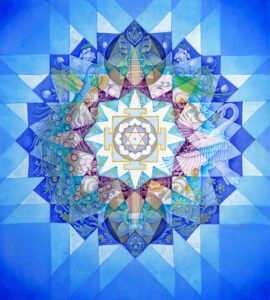 The Saraswati Yantra is a powerful spiritual tool used by practitioners to invoke the blessings of Saraswati and harness her divine energies for various purposes, including academic success, creativity, artistic expression, and spiritual growth. Saraswati Yantra is to invoke the blessings of Saraswati and seek her guidance in matters related to education, learning, creativity, and communication. Students, artists, writers, scholars, and anyone seeking to enhance their intellectual abilities or creative talents may use this yantra to aid in their endeavors.
The Saraswati Yantra is a powerful spiritual tool used by practitioners to invoke the blessings of Saraswati and harness her divine energies for various purposes, including academic success, creativity, artistic expression, and spiritual growth. Saraswati Yantra is to invoke the blessings of Saraswati and seek her guidance in matters related to education, learning, creativity, and communication. Students, artists, writers, scholars, and anyone seeking to enhance their intellectual abilities or creative talents may use this yantra to aid in their endeavors.
Some practitioners may perform rituals and ceremonies to consecrate the Saraswati Yantra before using it for meditation or worship. These rituals may involve chanting of mantras, offering of flowers, incense, and other offerings, and invoking the presence of Saraswati through prayers and invocations.
Practitioners typically use the Saraswati Yantra for meditation, concentration, and visualization practices. By focusing their attention on the yantra and meditating upon its symbolism, practitioners seek to connect with the divine energy of Saraswati and invoke her blessings.

Rama Setu: Engineering of the Ancient World
9 MIN READ
Vishnu: The Preserver of the Universe
10 MIN READ
Shiva: The Destroyer and Transformer
7 MIN READ
Explore The Sagar Universe
Dive deeper into the worlds of Ramayan,
Krishna, Shiva and more.
EXPLORE NOW
Shop Collectibles
 Exclusive divine art prints, classical scriptures and
unique merchandise.
VISIT E-SHOP
Exclusive divine art prints, classical scriptures and
unique merchandise.
VISIT E-SHOP
Saraswati Yantra is a sacred geometrical diagram to invoke Goddess Saraswati. It bestows education, knowledge, and creativity to worshippers. It also enhances concentration an memory in students. The Yantra is contained in a Bhupur (a square with 4 T-shaped doors), the doors give access to the Yantra. The eight lotus petals represent 5 elements – Air, Fire, Water, Earth, and Sky, and 3 Gunas (vitrues) – Sattva (goodness), Rajas (passion) and Tamas (chaos). The six pointed star is a unique combination of upward and downward triangle which represents the union of male and female aspect of God. At the centre of the six pointed star is the central point, Bindu, which is the most powerful part of the Yantra and represents the Supreme consciousness or the Goddess Saraswati is the Hindu goddess of knowledge. She is associated with wisdom, music, art, and learning. She is one of the three main goddesses of Hinduism. Saraswati is the wife of Brahma and the sister of Shiva. She is depicted as playing harp (veena), holding Vedas, rosary, pot, and riding on her animal mount, swan. Within Hindu literature, Saraswati is known by many different names. Her titles include Brahmani, meaning the power of Brahma, and Brahmi, meaning goddess of sciences. She is also known as Vidyadatri, the goddess who provides knowledge, and Vagdevi, the goddess of speech. In Vedic literature, Saraswati is imagined as purifying water of knowledge.
The Saraswati Yantra
The Saraswati Yantra is a powerful spiritual tool used by practitioners to invoke the blessings of Saraswati and harness her divine energies for various purposes, including academic success, creativity, artistic expression, and spiritual growth. Saraswati Yantra is to invoke the blessings of Saraswati and seek her guidance in matters related to education, learning, creativity, and communication. Students, artists, writers, scholars, and anyone seeking to enhance their intellectual abilities or creative talents may use this yantra to aid in their endeavors.
Some practitioners may perform rituals and ceremonies to consecrate the Saraswati Yantra before using it for meditation or worship. These rituals may involve chanting of mantras, offering of flowers, incense, and other offerings, and invoking the presence of Saraswati through prayers and invocations.
Practitioners typically use the Saraswati Yantra for meditation, concentration, and visualization practices. By focusing their attention on the yantra and meditating upon its symbolism, practitioners seek to connect with the divine energy of Saraswati and invoke her blessings.
Rama Setu: Engineering of the Ancient World
9 MIN READVishnu: The Preserver of the Universe
10 MIN READShiva: The Destroyer and Transformer
7 MIN READExplore The Sagar Universe
Dive deeper into the worlds of Ramayan, Krishna, Shiva and more. EXPLORE NOWShop Collectibles
Popular
Categories
Artists

Authors
Devi Bhagvat Puran

Festivals of India
Itihaas
Jai Ganga Maiya
Miscellaneous